 Swap Assistant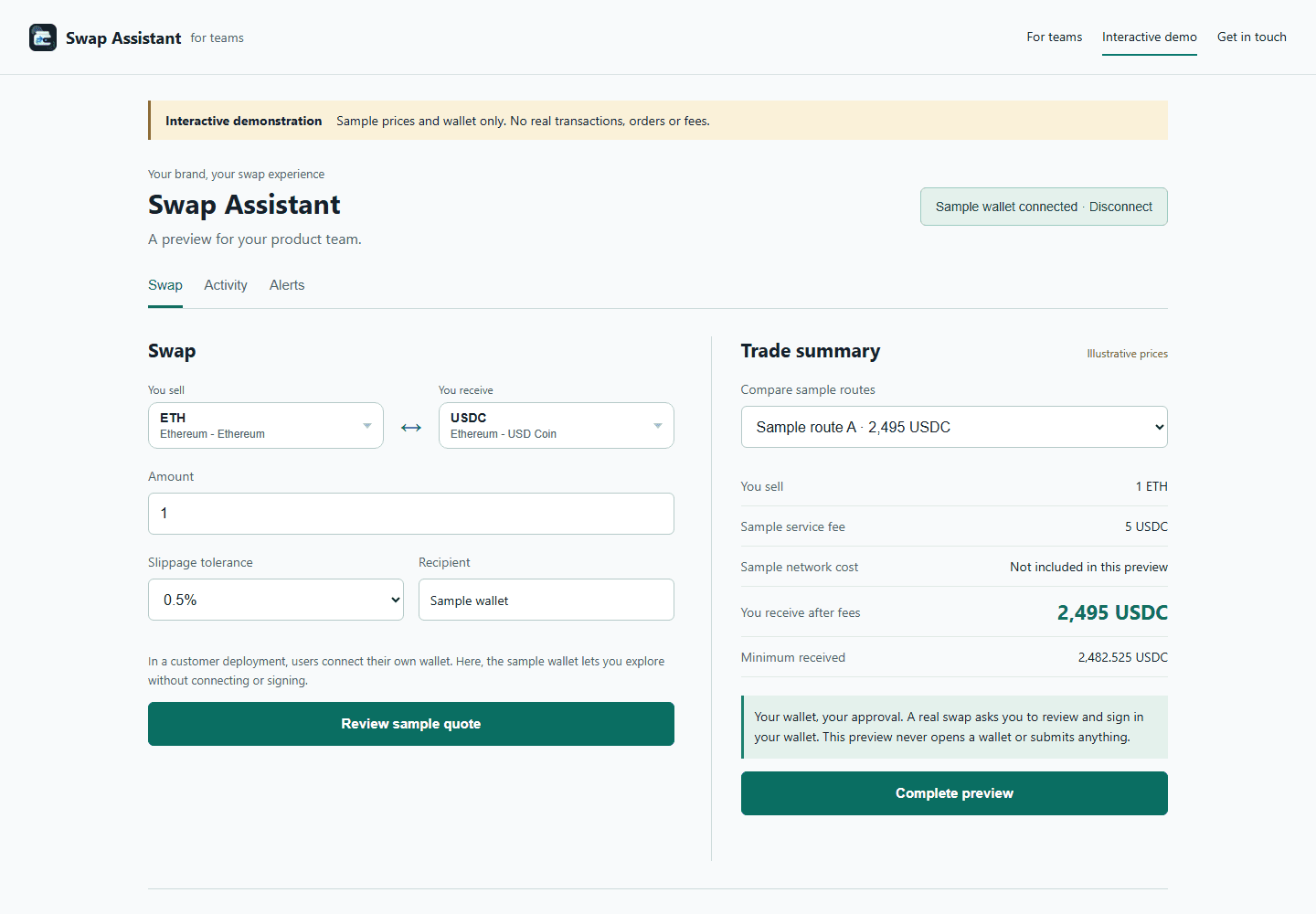
An API response is not a complete user journey
A provider can return a route and transaction data. Your product still has to explain approvals, show what the user will receive, handle quote expiry and rejected wallet requests, and distinguish submission from completion. Those are the parts you can evaluate in our working demo.
Swap Assistant uses a Next.js/React frontend for the user workflow and server-side quote handling, with a Spring Boot/PostgreSQL backend for authenticated history, preferences, alerts and operations. Provider credentials remain server-side. Integration starts by mapping these boundaries to your existing product.
Define the interface with your team
We first review how users enter the swap flow, which wallet model you use, the networks and assets that matter, and where the result belongs in your product. A linked branded deployment may be enough; deeper embedding or native mobile work needs a separate scope.
- Entry point, branding and return navigation
- Wallet and recipient compatibility on desktop and mobile
- Quote expiry, slippage, approvals and minimum-received review
- History, notifications, infrastructure ownership and acceptance tests
Same-chain and cross-chain are different integrations
Supported same-chain routes use configured providers such as 0x. Supported cross-chain routes use LI.FI and require additional recipient, network and delivery-state checks. Source-chain confirmation is not proof that destination funds have arrived.
Availability depends on current provider support, account permissions, amount, assets and route conditions. We agree testable route examples rather than promise all tokens on all chains. A failed quote must remain a clear failure, not a route invented by the interface.
Review security as a boundary, not a badge
The existing code includes validation, origin controls, rate limits, protected administration, automated tests and release checks. Fee reporting separates expected amounts from independently evidenced settlement. These controls are inspectable; they are not a claim of independent certification or zero risk.
Users sign ordinary swaps in their wallets. Supported limit orders are a separate, explicitly signed protocol flow. Market Radar does not execute trades. Your own security and legal review, provider onboarding and real acceptance tests remain part of deployment readiness.
Questions before a pilot
Can we install a Swap Assistant SDK?
There is no generally available public SDK offer. We license the existing application and scope integration with your product. Native or headless interfaces must be evaluated, not assumed.
Can you reuse our existing wallet?
Possibly. We review the wallet connector, signing methods, networks and mobile return flow during scoping. A compatible brand does not by itself prove compatible signing behavior.
Will integration avoid every provider dependency?
No. Quote routing and execution still depend on external providers and blockchain networks. Your deployment needs appropriate accounts, limits and operating arrangements.